How not to be a local foodie

It was a beautiful Saturday morning. Idyllic, really. The sun was shining, the shoppers were hungry, and the produce was fresh. I was waiting in line at my one of my favorite farmer’s stands, waiting my turn.

The lady in front of me paid with a $20. She apologized for not having smaller change. If you google “how to shop at a farmers’ market” you will probably find something about carrying small bills if you can to make it easier for them. It’s a thing.

The farmer looked at her and smiled kindly. “That’s ok, ma’am! I know what you mean, though! You know, sometimes when you go to the drive-thru at McDonald’s and all you have is a $20 and it takes them f o r e v e r to give you change? I hate that.”

Her smile froze. She stared at him in disbelief, then said in a trying-to-remain-calm voice, “I NEVER eat McDonald’s.” She took her change and walked quickly away.

Now, I’m not saying that it’s bad to never eat McDonald’s. My kids have never eaten there, and I don’t remember the last time I did, either. Yay us. Or whatever. But friends, I am begging you, don’t be that guy. Don’t make people feel like crap because they do eat McDonald’s (especially if they are the ones growing your food). Do you like to be judged by other people just because they need to feel like they have made the right choices themselves? No? Well, that makes sense, because nobody likes that. And it uses energy that you could be putting into something so very much more productive. Like finding the correct change to use at farmers’ markets. Or really any of a number of activities that won’t conclusively brand you (and many of the rest of us who care about where their food comes from) as an elitist.

I apologize too much. Sorry about that.

I think it comes of not having apologized enough in the first 20 or 25 years of my life. With a naturally aggressive personality, I was unapologetically myself. And that sounds great, in a novel. In real life, where actions have consequences, sometimes we end up owing someone an apology even if we didn’t mean to cause them any badness. 

That is fairly new information for me. The idea that maybe I bear some of the responsibility for things I don’t intend is really difficult to get my mind around in a productive way. In the past few years I have begun to be made aware of the way other people react to things that I say and do. I blame my husband for this. J is always saying things like, “If your dad is making this face, you should probably stop talking right away.” And you know what? It’s EXHAUSTING. I never understood when I was younger why everyone thought it was so “brave” or whatever when I spoke my mind. Now I do. Speaking your mind when you have a clue about what it might do to other people is often terrifying. Sometimes I have even wished I was able to live my life without being outspoken.

Where I am right now is the place of apologizing all the time. When I’m late. When I’m early. When I’m on time. When I bring food. When I don’t bring food. When I say something and it’s awkward. When I say something in a really thoughtful way, and it’s still awkward. When it’s not awkward (I over-think things until I apologize just in case and then, well, it’s awkward).

Where I am going, I believe, is where I can be really clear about how much of a situation belongs to me. Maybe I’ll figure out which things are mine to apologize for, and which things just are what they are. One rule of thumb once I get to that place will be not to apologize if no one is upset, annoyed or even inconvenienced. What not to say:I’m sorry I want to make this meal instead of that other meal I suggested, even though you didn’t seem to care either way…will you still eat it?” 

I will think a lot about moments when other people are having their Big Feelings and while I will certainly own and apologize for things that are mine, I will not clumsily attempt to carry the blame for something that does not belong to me.  I will remember how much that can be like grabbing at the shadow of someone else’s baggage. Because if I do that, probably I’ll just trip and fall on my face, I won’t actually help them, and then they’ll still have their baggage just like before. In the end (okay, in the middle…), I’m finding that too much apologizing is no better than not enough.

Shadow Baggage


On surviving drama with a friendship intact

I have recently entered into some new friendships. As with any other friendship I am a part of, I have spent the first several months very intentionally observing. What communication styles are most effective, what is off-putting, what kind of foods people like, etc. It’s like learning to read. Kind of slow and clunky, with lots of sounding out words and stopping and starting again. This is what it’s like to be an outspoken extrovert who cares about other people’s feelings. And yes, it is exactly as much work as it sounds. But I don’t know another way to really be in relationship.

So the thing that happens is that at some point, every relationship has drama. It’s a thing. Not a single one of us is perfect; we are all works of art in progress in a broken world and we all bring varying degrees of brokenness and inability to deal with certain things to every relationship we have. For example: things I am unable to deal with rationally are gossip and people assuming the worst of my intentions.

When drama happens in a BIG way, it feels like the book I’ve been struggling through for months (or even years) was upside-down the whole time I was learning to read it.

It’s awful.

I think the reason so many of us have revolving doors on our relationship lobby is that we don’t know what to do after that happens. I mean, it was A Thing. But how do you talk about it? It was so bad and we don’t want to relive it. So either we walk out the door, so to speak (or maybe literally…), or we stay and pretend like nothing happened. Everything is fine. See? No one’s yelling or crying or leaving…at least not right now…I should admit right now that I am terrible at this option, as has been repeatedly pointed out to me over the years.

I think there must be another way.

What if we could look our drama in the face (sometimes after enough space and time has passed) and try to learn from it? What if we created a safe space to say, “I value your friendship and I care about you enough to want to really think about how we can communicate better”? It’s difficult, but what if we could not give up? Maybe the book was upside-down. It happens. Just keep going; keep sounding it out, one word at a time.

I do this. Occasionally, it makes my stomach hurt. Sometimes for weeks at a time. Authentic relationship is not for the faint of heart. But in my experience, it is so entirely worth it.


I feel like this post goes hand in hand with this other post.

How I Learned to Stop Worrying and Love My Children

So, I’ve had several interactions in the past few months that have left me with the unsettling feeling that either my kids actually are the worst (because of my parenting), or that the person I’ve just been speaking with is being, well, kind of a tool.

One thing about being an extrovert is that I thrive on positive interaction. People often assume that being an extrovert means that I am naturally great at being around people all the time. It doesn’t. It just means that I really, really want to. And that I really, really want it to go well. In parenting circumstances that translates into me trying to make my kids conform to ways of being that I think other people want or expect so that they will be happy when we are together (I really, really want other people to be happy. Really.). When I fail, when I can tell other people aren’t enjoying my kids, it (falsely) seems to boil down to either that I’ve failed at being a friend, or at being a parent, or both.

I don’t want to think that people I care about are self-absorbed or clueless (and even if that happens to be true for a second, we all have our moments and no one is just one thing). But it’s also entirely stressful to continually worry that my family stresses other people out or bothers them. So I try to make it better. Maybe if I just let them watch more tv, then I can have un-interrupted phone conversations. Maybe if I stop letting them watch tv, then they won’t ask for videos. Maybe if I let them eat whatever they want, they’ll just enjoy parties and other people won’t have to be weirded out by the crazy hippie mom. Maybe if I tried harder to keep artificial coloring out of their diet, they would have better impulse control and wouldn’t, you know, be kids.

Enough.

Who is my parenting for?

Is it for the random people in the grocery store who make an irritated face as they have to walk around my four year old because she is intently looking at something in an aisle-way and didn’t realize that they were waiting for her to move (ahem-grownups, use your words…)? Is it for people who I can’t talk to without getting interrupted every minute and a half? Is it for anyone who has ever expressed frustration about my kids’ behavior?

The answer to all of these questions is no.

My parenting is for my children. That sounds cheesy, but it’s true. If I spend all this time and energy trying to make sure other grownups (even ones that I like very much) are approving, then I will ultimately benefit no one. I probably won’t even satisfy the person I am trying to please; so far my children, like me, seem to be themselves no matter what they try to do to fit in. If I try to incorporate everyone’s opinion into my relationship with my children, I will teach them that pleasing other people is more important than being clear about who I am. And if I teach them to please people all the time, they will not learn to be themselves in the world. Or, at least, it will take them a lot of extra work. I mean, learning to be who you are meant to be on the planet is hard enough without your mother muddling it up trying to make sure some judgy lady at the library can get to the magazine stacks faster. I am a person of faith, which means that as I go, I trust that God will teach me and lead me into truth. Sometimes that will be in the form of a friend sharing something true with me. Sometimes it won’t.

One final thought. Just to be clear, getting input from a variety of sources is great, and necessary. There is so much helpful information out there to be had. And so many wise people who have such great ideas that really can help me to be better. I welcome constructive idea sharing. It is how I learn and grow as a person, as a parent. I need to be challenged; I crave it. But I’m really kind of over trying to make sure that everyone I meet is pleased by how I parent my kids.

An Open Letter of Apology

Dear Curtis,

We haven’t spoken in a while. I see your posts on Facebook sometimes and it makes me smile to remember some of the things we did…remember falling asleep on top of our music history books and then hoping some of the information had seeped into our brains by osmosis? Sneaking out of aural training class because the thought of MacGamut was almost painful compared to the idea of Chipotle on the Oval….you were one of my favorite friends in college.

But there were other things going on, too. When you came out to me, I felt like you were sharing this very vulnerable, scary thing for you, and I didn’t have a clue how to handle it. There are a lot of things that I wish I’d said differently to you. The only thing I can say is that I was doing the best I could with what I knew. But still, I am so sorry, my friend.

When you told me, my first reaction was to look for someone else who had some experience dealing with this. I heard about an anonymous group of guys that met to talk about “that stuff” (I still don’t know what they actually talked about, but I asked around my local church without using any names for “a friend” and was told to suggest you seek them out, and like a good little soldier I passed along the message). When I told you, you said, “Yeah, R said his mom tried to send him to a group like that. It didn’t help him.” I honestly don’t know that I wanted them to “fix” you or “pray away the gay” or anything like that, but I knew I didn’t have anything wise or helpful to say. I was terrified that this thing I’d always been taught was wrong was happening to you. I’m saying it happened to you because I don’t think you chose it. But you were becoming one of Them.

Suddenly abstract positional statements like, “Homosexuality is wrong” had a very dear face associated and I kind of freaked out. What does this mean for me? How do I react to this? How do I love my friend after something like this?” It fills me with shame to admit that this was my reaction. Even now it brings me to tears to think about it. I wish I could go back and shake myself and say, “WHAT IS WRONG WITH YOU? THIS IS NOT ABOUT YOU!! Your friend is going through something really hard and confusing and you’re worried that, what, you might have to take a stand against him? How selfish are you?”

Luckily those initial freak-outs were not the end of the story. The sweeping judgments were not able to stand up under the light of true friendship. I had a lot to learn (I still do) but I was clear enough to at least know that I would not stop being your friend because of this.

Then later (gulp), I invited you to my local church…you and K came one week because they had made an announcement: “Some College Preacher will be talking about Homosexuality. Bring a friend.” Well, this may help our conversation. Someone more qualified than me will address this issue. At the end of the meeting, K stood up and said, “I gotta get the HELL out of here.” I was shocked by that, as SCP had been outlining rhetoric I’d heard my entire life. Like a good little evangelical, I followed up with her the next day and she said a bit tersely (I don’t blame her), “Thank you for inviting me to your lecture.” I am sad about having put her in that position, but that conversation permanently altered the way I think about the Church, what it is, and what it is not. I am so grateful to her for that. But that’s another letter.

When you told me that you were researching what the Bible says about homosexuality, and that you thought the Bible was very clear, I agreed without really giving it much thought. I didn’t really dig into the words with you, because I assumed I already knew what they meant. I wish I hadn’t. Whether I reached the same conclusion as before or not, I should’ve looked into it more. I was afraid and selfish and I’m sorry.

Still, after all that, you stayed my friend. You even took me to my first gay bar…I have to say, it wasn’t the seedy den of iniquity I had expected. Not to perpetuate a stereotype, but it was super clean and people were generally very well dressed. And you know what? A girl can enjoy a drink and clever conversation without skeazy guys hitting on her. It was tremendous. But one thing you said to me then has really stuck with me. You said that I was better at being a Christian than you were.  At the time, (knowing myself) I knew that was absurd, but I wasn’t sure what to say, so I said nothing. Maybe a little part of me was afraid it was true, in which case I knew a lot of people who I considered to be better at a lot of things than me so we would both be screwed. You were just reflecting back what the culture taught; that good christians aren’t gay.

If I could go back and change one thing, I think that moment would probably be it.  Maybe this is the part where I’d shake you. Maybe I’d even laugh. “Have you met me? Sometimes I’m the worst. I’m definitely NOT better at  being a Christian than you.” I’d say matter-of-factly. I wish I had been able to encourage you to just seek God and trust that God could take care of what you needed to know. Why did I feel like I needed to stand in between and make sure you matched up to my list of qualifications for relationship with the Maker of both of us? Why did I think it was necessary to decide what I thought about your life? You are my friend and I love you. I have to think that God is better able to sort out what you need a talking-to about than I am.

A couple of closing thoughts: Even if the Bible is as clear about condemning gayness as I believed growing up (before I knew any actual gay people), even if it is actually a sin, so what? What does it help to continually point it out and take a stance on it? There are a lot of other things roundly condemned in scripture. Where are the protest signs that read “God hates Gossips” or “Impatient people will BURNNNN”?

I have come to believe that the Bible was not meant to be a weapon against my neighbors, and I am sorry for the way I publicly participated in it being used as such against you. And so, with fear and trembling, I hope you will accept my public confession and apology.

Your friend,

Kat(i)e

Speak Well of Your Children

As a parent I am my child’s primary advocate. Especially when they are small, what I say about E and S is the first and strongest impression people will receive about them. What do I want people to think about my children? If all I talk about is how they scream when I try to dress them, or the times when they don’t listen, or the messes they make, then it’s like pointing at the mess on the floor. Now it’s all you’ll notice. If I offer up other information, though, then other people have much greater opportunity to think well of my children.

It is so tempting to look for some sympathy. Parents of young kids are often tired. Believe me, I get it. It’s overwhelming, the completeness with which they need us. I know. And I’m not saying you shouldn’t find a safe space to process that out. You absolutely should. And please hear me correctly: I’m not saying we should pretend to be perfect, or that our children are. But if you really need to let off steam about something, it ought to be to someone who can think well about you and your kids, otherwise they won’t actually be helpful. If someone can’t think well about your kids, at best all they can do is say, “man, that sounds really hard,” and join in your pity party. At worst, they will agree with you that your kids are terrible. As parents, do we really want to encourage other people to think our children are the worst?

Consider two takes on the same book:

I just read this book; it’s about a bunch of people living in a fake place and they go on a trip or something and get lost in the woods and get separated and some of them die. And they’re fighting over this ring. I guess I liked it.

I just read this book; it’s about relationship, and how we can support each other and overcome anything, even if the odds seem terribly against us. It’s an epic story of courage found in the most unlikely places and it changed my life.

Which would you rather read?

Raising a Woman of Valour (and hopefully becoming one myself)

Lindsey Lohan. Brittany Spears. Khloe Kardashian (or some other Kardashian…I don’t know; aren’t there about three of them that are famous?). Barbie. Whatever “Bratz” is. Biblical Womanhood. Patriarchy in the Church. Women’s liberation. Feminism. Mean Girls. The mean girls in our neighborhood. Buffy. Bella. OH GOOD LORD, Bella. A flawed, tired mother.

My daughter is bombarded. I am bombarded with her. Megan at SortaCrunchy has written very thoughtfully on this topic. It is so overwhelming to think of how many different messages she will receive in her lifetime about how she should be defining herself; and about how she should be understanding herself to be in the world. Not that she knows what all of these things are. She’s only four and a half. But she will. And right now, what she knows is mostly me.

To quote Tina Fey, sometimes I’m the worst. I get so cranky. I’m tired. I hate saying that when people ask me how I’m doing. I don’t like the sympathetic head tilt, or worse, the judgment of the fact that we haven’t nightweaned or just plain old weaned our 17 month old. For whatever reason, I’m not managing my stress too well these days. J would love to give me a break or help me in some way, but I don’t even know what have him do. He helps with housework, kids, diapers, and a host of other things when he’s around. It’s not his fault. But still I struggle sometimes.

The thing is, I don’t think that being a woman of character waits until your kids are sleeping through the night. It doesn’t wait until you are not overwhelmed. Part of me wants to claim that excuse and live in it like a comfy sweater; I am allowed to be mean to you because I am tired. If I just wasn’t up at night, I would be able to do a better job. 

The problem is, that will be too late. E is starting to absorb this behavior. Remember, I am her normal. When I apologize for slamming a door or for speaking too harshly, she says, “I didn’t think that you were being mean, but I forgive you.” This is the worst part for me, because it means that she has learned from me that this is how people are with each other, and it kind of breaks my heart. Kids do not immediately see meanness as meanness. They will assume that they are the problem, and that they deserve it. And eventually, they will start to pass that on to other people. E has started making the most awful (and awfully familiar) grimaces at her brother.

But parenting is a relationship, and you get more than one chance to make an impression. It’s possible that her first memory will be some mean thing that I did or said. But hopefully she will also remember that I apologized and made real efforts to become more gracious. That I never claimed to be perfect, but that I never gave up trying to be my best.

But I can not be everything that a woman should be. No one woman can be everything that a woman should be, and so I am always looking for really great women to talk about with my daughter. It is inconsistent to think that we can obsess over and emulate shallow people and yet raise women of character. I think the first step to becoming and raising women of character is to value those things at a societal level.

So I will present, for your consideration, a few women who are famous in our house.

This is Beatrice Mtetwa. She is a human rights lawyer in Zimbabwe and has risked her life and safety to tell the truth about corruption in that country. We heard her speak last summer, and Elizabeth wore pink for her because in our reading about her we found that it is her favorite color.

This is Chloe Hopson. She is the founder and Executive Director of Passport Project, which is a Cleveland organization working toward better cultural understanding and promoting a more healthy, aware and peaceful society through the arts. She is one of the most openly passionate people I know and cares very much about fighting against the racialized ways that our culture functions without many people even knowing it.

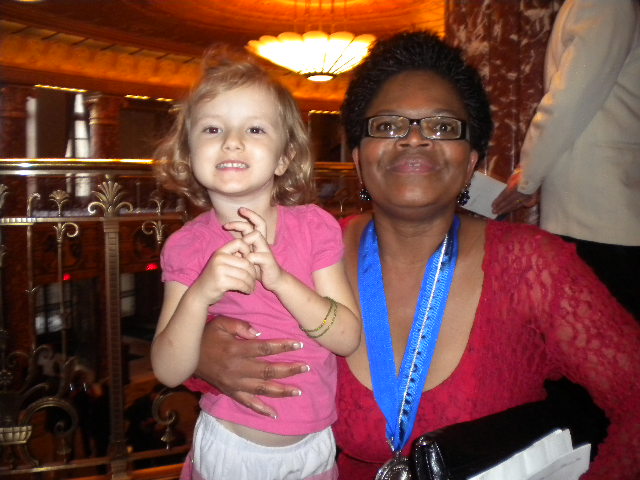
This is Mayim Bialik (I’m on the left there). She is a tv star, but I still admire her very much anyway. Because she’s an observant religious person in Hollywood and in the scientifc community, she homeschools, she has a Doctorate in Neuroscience; she’s also just very thoughtful about a lot of things that I care about, like encouraging non-competition between moms, and buying socks from American Apparel because they are sweatshop free even if you do have to make sure your kids don’t see anything super awkward in the process causing them to ask you questions you may or may not be prepared to answer, or to make comments that you find very surprising. I interrupted her bagel-eating to take this picture in which I do not at all look like a crazy super-fan. Ahem.

There are so many more people who are famous in our house than there is space for in a single post!

People like our neighbor Danielle, who homeschools her children who are 10, 6 and under 1. Her older two have taken my daughter under their wing and as I type this she is at a drop-off playdate at their house. She gives me hope that my kids, too, might survive my parenting. Maybe even to age 10.

My friend Audrey, who runs a business from her home and is just generally a really great friend. She is the mother of Everett, who I recently found out is also E’s imaginary friend. That’s how much we like their family.

My friend Michelle, who opened her home to me when I needed a place to stay a few years ago and was my first real grown up housemate. A lot of little unconscious things I do in my household are because of her. My friend Catherine who, among other things, came and found me when I was giving birth and whose voice is the one I hear in my head when I am trying to sound calm and reasonable and eco-friendly.

My mother, who is my normal and who built the framework for how I view the world. My MIL, who did the same for my husband, working very hard as a single mother for his formative years.

I think I’ll stop there for now. But it is encouraging to have such a great cloud of witnesses to what being a woman is. The more wonderful women I can look at and think, “Wow, I’m glad she’s in the world,” the less I feel pressured to do ALL THE THINGS and the more I feel freed up just do my thing.

Tamara Taylor, I think I love you. (Bones takes on racism for a second).

Dr. Saroyan addresses structural racism and classism in America in a quick Bones Clip. UPDATE: I had the clip but it expired on Hulu so is no longer available. Sorry about that. Here’s what they said:

Brennan: Our victim was a member of the lower caste.

Daisy: (matter of factly) We don’t have castes in America.

Dr. Saroyan: Wow. Would you care to look me in the face and say that?

Clever little moments like this are what make me like this show so much. Coming from a Daisy Wick sort of a background (that is, not intentionally racist, but very naive, and completely unaware of unfairness and inequal opportunities that people have in my country), I really liked this a whole lot, and I feel like people who grew up in similar ways need to hear this.

Daisy Wick-style cluelessness is understandable (people can’t help where they are born and how they grow up) but I think a lot more of us need to be talking about this because (as I found out eventually) this sort of cluelessness only makes the problem worse. And at some point we must choose whether or not we will stay ignorant.


A Little More About Muslims and Angry Mobs: The Longform Sign

So, a few days ago, in the wake of what happened in Libya, I came across this article:

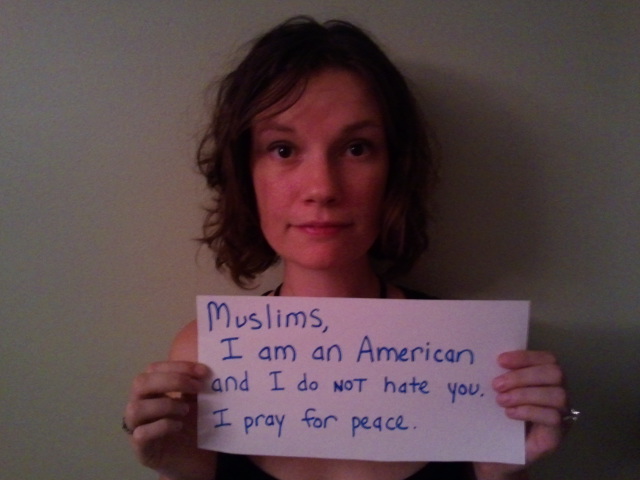
I don’t know any of those people, and I don’t know that they’ll ever see them, but we posted these pictures in response.

J and I posted them as our profile pictures on Facebook, and there were some…well, some reactions. A lot of people liked them. Some people didn’t. That’s okay. We don’t have to be everyone’s best friend.

But there seemed to be some misunderstanding about what was meant.

Here are some of the comments:

“The picture is suggesting that americans hate muslims… which is not true for the most part. It is true that many americans are incredibly misinformed about islam and couldn’t tell you one thing about it, but the small percent of muslims that hate america do so for what I would consider a very good reason.”

“tiny percentage of muslims mainly in the middle east that have directly been impacted by western imperialism and wish to avenge all the awful things the american government has done to your countries,
I do hate you, and I hope you rot in hell for all the bombings, shootings and terrorizing of innocent people that you have done. I would not care if you were shot dead, but I would prefer it if you were simply incarcerated. You give your religion a bad name and with it, an awful stereotype that ignorant, uneducated Americans are willing to believe simply because they are to stupid to realize that Islam is not a terrorist organization. You assisted in ruining an entire region and causing numerous wars and global conflicts. You caused the demise of several of your own countries, and increased a global hatred towards your race. to the other 99 percent of muslims, you should try as hard as possible to make sure that these few people do not define your religion as a whole.”

“and hes (referencing the above commenter) right. If she is infact trying to talk to the “muslims” who i think she means the ones who are extremists and rioting then we all should hate them. How is that wrong hate people who have terrorized Americans and others for years and years”

“I don’t hate muslims, nor do I blame all muslims for what happened. Unlike those criminals, I know words or actions of one man should not be used as the death warrant of another. Maybe they don’t teach “sticks and stones…” there, but they should.”

Here is my response to that:

“Dear Muslim brothers and sisters (as we are all human beings and therefore related in some really important way), I am saddened by the violence taking place in the name of Allah, and the backlash being associated, wrongly, with living the life of Jesus in the world. I can’t speak for your religion, but I can tell you that Jesus is in no way honored by unexamined hatred of an entire people group. As angry mobs of rioters do not represent every Muslim person, neither am I represented by a despicable movie designed only to ignite more violence. Most Americans don’t hate most Muslims, and vice versa. I don’t want to hold on to hatred of anyone, as I don’t think that helps anyone. It does not bring back the murdered, and it does not even really do anything to the murderer. If I hate, the worst damage is to my own soul. To turn back hatred we need stronger stuff. Oil doesn’t clean itself off the kitchen counter…you must flush it with lots of water. Sometimes very hot, sometimes with soap, but just adding more oil will never, ever make there be less oil.” 

Would have been hard to fit on a sign.

Here are the rules I try to follow for myself when reading the news:

1. Avoid sweeping generalizations. Something that is true of one person may not be true of another single person, let alone a whole people group. “Muslims, I don’t hate you,” is not a bad sweeping generalization because even though I was very general in whom I addressed, I was stating something that should be true anyway. We, as Christians, are commanded not to hate people (whatever we think about their actions) because they are created in the image of God. I have been given the gift of understanding how to not hate them (I wonder occasionally if I was related to Chris Stevens whether I would still understand and still be able to forgive. I hope so, but that is not what my life is).

2. Reserve judgment about what someone is thinking, or why they are acting in a certain way. The person writing the article may not be completely objective, or have all the information.

3. If the thing I am about to say starts with, “Over there,”  “Those people,” or something like that (especially about a place I have never been and know very little about culturally),  then it is often not worth saying.

4. Ignorant and bigoted people usually don’t know that they are ignorant or bigoted, and will make fun of other people for being what they are. I have noticed this a few times with hardcore fundamentalist christians who condemn the rest of the world for not meeting standards that they can’t meet either, as well as with angry atheists who assume that any kind of faith makes you weak-minded and are so blind to the way that they generalize “Those Morons in Churches” that they will make ridiculous declarative statements without even thinking them through all the way. Use caution when engaging in debate in this setting. If someone is more interested in belittling what they don’t understand, it is very hard to get past that to actual productive conversation. I have made copious use of the “hide” and “unsubsubscribe” buttons so I don’t get sucked into circular arguments or end up saying like J does in these circumstances, “I have to go! Someone was wrong on the internet!”

5. React emotionally, but realize that is what is happening and then try to think critically about it.

I find myself, sometimes, falling into the “silent majority.” The lack of exclamation points, Caps Lock, and words that are more inflammatory than substantive does not mean there is a lack of thought, passion, or meaning. I don’t always feel like screaming helps, but that doesn’t mean I don’t have something to say.